Thursday, November 10, 2011

Just An Update

With Friday as Veteran's Day, it's a three-day weekend here and I am ecstatic. Although I've been feeling quite down due to my health issues, I am finding the simple pleasures in life that make me smile again:

* Kepi surprising me with a bouquet of flowers and a card at home. It's a wonderful feeling to come home and be surprised.  Thank you, Kepi.
    * Mom getting me this cute coin purse. I love it! I bring it with me even if I don't have any coins at the moment. Thank you, Mom.
      Purse

      * Spending the weekend in New York City - I can't wait to walk around Times Square, visit the Rockefeller Center, eat NY Pizza and maybe spend a cool, crisp, fall afternoon exploring Central Park.
        * Having lunch at Max's Chicken in New Jersey. I also would love to pick up some Filipino pastries and sweets at the Philippine Bread House. A bunch of Ensaymada would be nice.
          * Downloading new Christmas songs from iTunes. It seems that Christmas songs do wonders to my soul. I just love listening to them. 
            * Planning for the holidays. I can't wait to put up the tree this year and also get started with my Christmas shopping. I am tapping my fingers for Black Friday.
              * Preparing holiday cards for mailing.

              * Surviving the first semester in grad school, I only have two final papers to go.

              * Trying to manage my treatment well and positivity is slowly seeping into my every day life.

              I hope everyone's doing well. Alohas!


                    Wednesday, November 9, 2011

                    Stockholm's Millesgarden

                    Millesgarden is an art museum and sculpture garden, located on the island of Lidingö in Stockholm, Sweden. It is located on the grounds of the home of sculptor Carl Milles and his wife, artist Olga Milles, who are both buried there.
                    Carl Milles was born and raised in Lagga near Uppsala, the son of an officer, major Emil Anderson. Carl's mother, Valborg died when he was just three years old. Carl began his schooling in Stockholm, but left prematurely and became apprenticed to a cabinet maker. Later he attended evening classes in woodwork, carving and model­ling at the Stockholm Technical School.

                    In 1897 Carl was awarded a grant by the Swedish Handicraft Society, permitting him to travel to Paris, where he supported himself doing ornamental carpentry while studying anatomy at Ecole des Beux-Artes. Beginning in 1899 he had original sculpture at the Paris Salon and continued to exhibit there each year until 1906. (Source)
                    Europe and the Bull - the largest fountain at Millesgarden.

                    The stairs lead to the Milles' house and studio.

                    St. Martin Fountain - The fountain is Carl Milles' last completed work of art. Carl Milles chose the legend of St Martin as a subject for the fountain. The holy Martin was a saint from the fourth century who was very charitable and gave to the poor. Here he is cutting a corner of his cloak to give the reclining beggar as clothes. This is also an equestrian sculpture, and just like Folke Filbyter, the horse and rider are twisting in different directions, thereby creating a powerful movement. On either side of the rider there is an angel and a faun. (Source)

                    The Sun Singer at Millesgarden which depicts a naked male body, with no head or arms.(Source)


                    God's Hand

                    God's Hand - A small man is standing on a large hand. He is looking upwards and his body is tense, with fingers splayed. The man is balancing on the index finger and thumb of the large hand, a feat that seems difficult enough in itself, but his exertion is of another nature. He is gazing with rapt attention at something in the sky, as though he were receiving a message or taking part in a dialogue. (Source)


                    Folke Filbyter

                    The Little Triton


                    A peek into the Milles' studio.

                    The Sussana Fountain - Grand Prix winner at the Paris Exposition in 1925. In the middle of a sunken ornamental pool on the upper terrace of Millesgården, stands a key work by Carl Milles, the Susanna Fountain. The sculpture is hewn from one solid block of black granite in the compact style with smooth surfaces and soft contours that is characteristic of Carl Milles' work from this period. The granite is from Glimåkra in southern Sweden. Many of Carl Milles' sculptures are placed in fountains or pools, and Milles was often inspired by stories from the Bible, astrology or Greek mythology. (Source)


                    The Aganippe fountain 1955 - Aganippe was the name of a spring gushing forth from the mountain of Helicon, according to legend created where the winged horse Pegasus alighted with his hooves. Aganippe was the muses´ holy source and had the virtue of conferring poetic inspiration on those who drank from its waters. The muses were the patrons of arts and sciences. Each one of the nine muses represented an art or science. (Source)


                    The other artists featured at the Millesgarden are:
                    Olga Milles: Olga Granner's long years of art studies began in Graz at Landschaftliche Zeichen-Akademie 1886-92, with the prospect of later becoming an art teacher. Her education continued with a scholarship to Azbe-Schule in Munich 1893-95 and was completed at Academie Colarossi in Paris, 1899-1901.

                    Ruth Milles: Sculptor Ruth Milles was born April 19, 1873 at Bällsta Manor in Vallentuna. She began her art studies at the Tekniska Skolan in Stockholm, 1890-93 and continued at the Royal Academy of Art, 1894-98.

                    Upon completion she travelled to Paris, where she remained for several years executing sculpture and illustrations. Her summers were spent in the village of Briac in Britanny, depicting the fishing folks life in sculpture. Ruth Miles was awarded the Special prize in the Paris Salon 1902. (Source)

                    Monday, November 7, 2011

                    The Oresund Bridge And Souvenirs

                    Of course while in Stockholm, I couldn't resist purchasing some souvenirs. And, my visit to a city or country is not complete until I taste their very own sweets or chocolates. I've collected quite a number of fridge magnets now, and it seems that they're now my favorite item to collect; it used to be postcards.


                    Anyway, apart from the souvenirs that make me excited, the Oresund Bridge was one cool bridge that amazed me. Connecting Sweden and Denmark, the bridge is over 10 miles (16,4 km) and is the connection between the metropolitan areas of Copenhagen and Malmo. Built in 1991, the bridge is perfect for travelers wanting a quick connection between Sweden and Denmark without flying, the Oresund Bridge now carries more than 60,000 travelers daily - amongst them both local commuters and visitors. The Oresund Bridge offers a 4-lane road carrying 6 million vehicles per year, and two train tracks (another 8 million people each year). (Source)

                    Here are a few shots I took of the bridge:


                    I hope everyone is having a spectacular Monday!

                    Monday, October 31, 2011

                    Sweden's Gamla Stan

                    After Estonia, we embarked on our trip to Stockholm, Sweden. On the bus en route to Stockholm, I was amazed at the vast open lands in Sweden's country side. There were so many trees, farms, mountains, grazing horses on the hills and the road to the city was littered with beautiful purple flowers. All I could think of was getting off the bus to pick up wildflowers. I was impressed at how naturally beautiful the country side is. I told myself that next time, I'll plan on visiting the country side of Sweden. For now, Stockholm will do.

                    At about 9 am, we approached the island of Stadsholmen and the medieval town of Gamla Stan (Old Town) stood there waiting to be explored.  Gamla Stan emerged in the 13th century and is home to Sweden's Royal Palace. This Royal Palace is one of the largest inhabited palaces in the world with over 600 rooms. In addition to the reception rooms, there are several interesting museums in the Palace, including the Royal Armory, with royal costumes and armor.

                    Sweden’s national cathedral - Stockholm Cathedral

                    I love these iconic buildings at Gamla Stan's Stortorget (The Big Square).

                      It was one beautiful day in Stockholm - not a cloud in the sky.

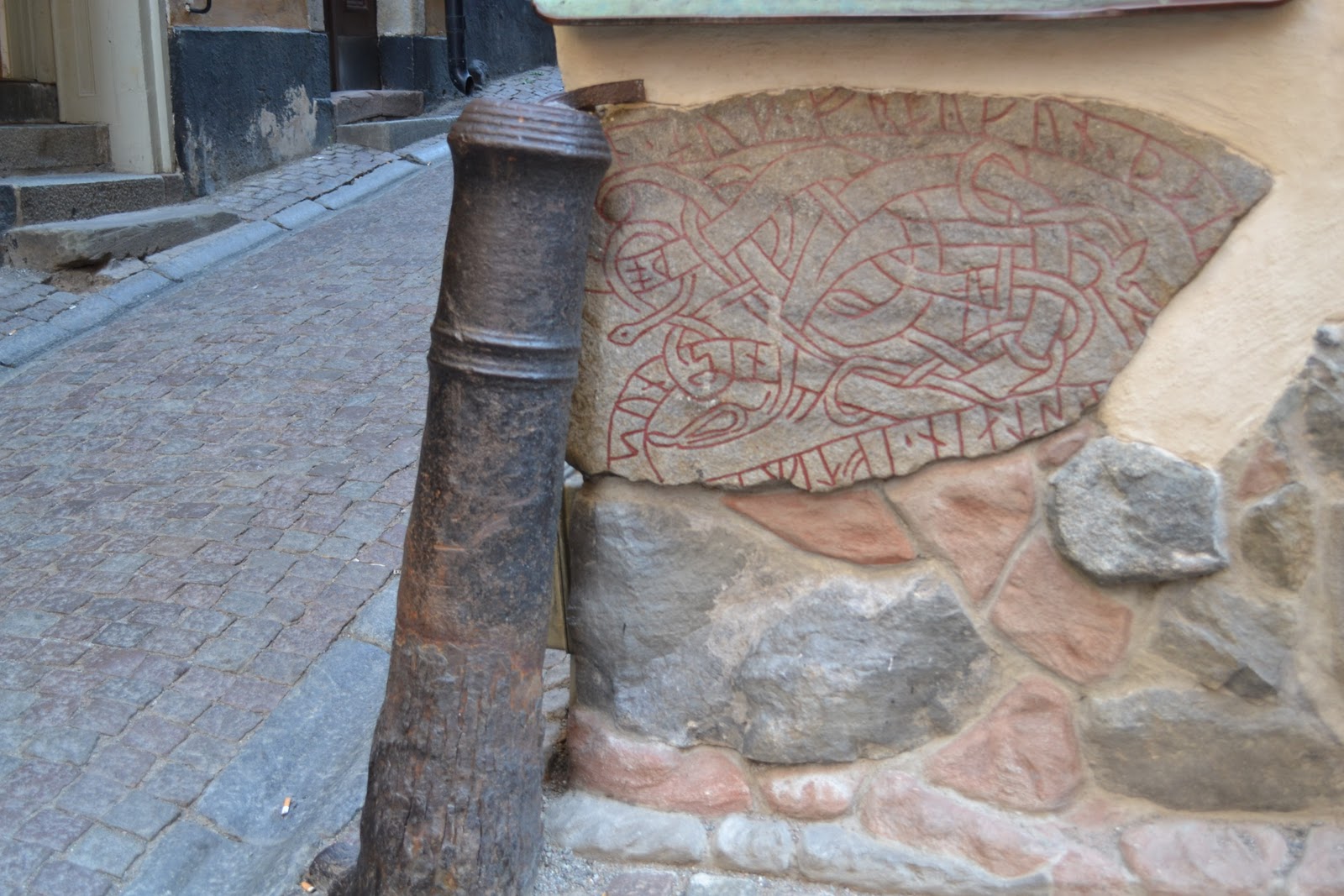
                      Viking runes at one of the streets in Gamla Stan.


                    Mårten Trotzigs gränd or Alley of Mårten Trotzig is less than a meter wide with 36 steps down. It is the narrowest alley in the city.


                    The harbour of Skeppsbron, the eastern waterfront of Gamla stan.

                    The Royal Palace.

                    Luckily, we were in time to watch the ceremonial changing of the guards at the Royal Palace.
                    

                    Tuesday, October 25, 2011

                    Fall With Me

                    At the Skyline Drive on October 22, 2010, the beautiful shades of fall witnessed a grand event - Kepi's proposal.

                    Friday, October 21, 2011

                    Tallin's Olde Hansa

                    You have to taste a host country's food, that's the beauty of travel.

                    While visiting Tallin, I really wanted to eat authentic Estonian food, so we walked around the old city to find something that would fit our budget and our taste buds.  We passed through Olde Hansa a couple of times, checked out the other restaurants but we decided to go back to Olde Hansa anyway; we made the right decision.

                    Olde Hansa had the right medieval feel and the servers were so warm and welcoming; they were also wearing medieval clothing. The restaurant was lighted with old lamps and candles, Estonian music played in the background, the hard wood tables flickered with the candlelight and the walls brightly festooned with draperies. It was the perfect place to fill our empty stomachs, rest our achy feet and wipe our sweaty brows and paws.

                    Walking around to find a place to eat.

                    I love the draperies, the lamps and candles.


                    The servers taking a break.

                    Candles lighted the stairs to the restrooms. I love the soot all over the wall.


                    Menus by candlelight.


                    This stall sells roasted nuts.

                     I had a glass of Blackberry juice which was really delicious.

                     Kepi had the bear meat. He said the meat was delicious and compares bear meat with beef only a littler gamier in taste.

                    I had the Wild Boar meat. The meat was tender and really tasty. I will definitely have this again and the berries really complemented this dish.

                    ----------
                    To those who'd like to read more about my personal updates, please visit my personal blog - kassidy's notes.

                    Thank you to those who kept checking on me.

                    Wednesday, October 12, 2011

                    Climbing St. Olav

                    Here's a little history of St. Olav's Church:
                    St. Olaf’s Church or St. Olav's Church (Oleviste kirik) in Tallinn, Estonia, is believed to have been built in the 12th century and to have been the center for old Tallinn's Scandinavian community prior to the conquest of Tallinn by Denmark in 1219.  Its dedication relates to King Olaf II of Norway (a.k.a. Saint Olaf, 995-1030). The first known written records referring to the church date back to 1267, and it was extensively rebuilt during the 14th century.

                    A legend tells that the builder of the church, named Olaf, upon its completion, fell to his death from atop the tower. It is said that when his body hit the ground, a snake and a toad crawled out of his mouth. There is a wall-carving depicting this event in the adjoining Chapel of Our Lady.
                    Around 1500, the building reached a height of 159 meters. The motivation for building such an immensely tall steeple must have been to use it as a maritime signpost, which made the trading city of Tallinn visible from far out at sea. Between 1549 and 1625, when the spire burnt down after a lightning strike, it was the tallest building in the world. The steeple of St. Olav has been hit by lightning at least eight times, and the whole church has burned down three times throughout its known existence. Following several rebuildings, its overall height is now 123.7 meters.

                    From 1944 until 1991, the Soviet KGB used Oleviste's spire as a radio tower and surveillance point. It currently continues as an active Baptist church.

                    The tower's viewing platform offers panoramic views over the old town and is open to the public from April through Nov, daily 10:00 - 18:00. Admission 30kr (1.92 €). ( Source here.)

                     I'm short but I still had to stoop when I entered this door.

                     The spiral stairs of St. Olav's Church.

                     While climbing, make sure to hold on to the rope because the pathway is narrow and the steps are uneven.

                     Small window.


                     I was soaked in my own sweat while climbing the tower of St. Olav. I was puffing and huffing, but all my tiredness was swept away when I saw the spectacular panoramic view of Tallinn.

                     Really worth the climb.

                    From here, I could smell the sea.


                    After descending from the tower, we spent sometime exploring the church.

                    If you find your way to Tallinn, I highly recommend climbing the tower of St. Olav's Church.